

Activists pile pressure on SEDFA to disclose spaza fund beneficiaries

Caption:
A spaza shop owner sells to a customer.
📷 SIMON MATHEBULA
South Africa is entering a new era in its 34-year old democracy where its citizens are demanding greater accountability and transparency from government institutions.
This new culture is being fully demonstrated by the South Africans for Constitutional Reform (SACR), which is putting pressure on the Small Enterprise Development and Finance Agency (SEDFA) to publicly disclose beneficiaries of the government's R500 million Spaza Shop Support Fund (SSSF).
The civic organisation, led by Princess Mthombeni, argues that, as a publicly-funded initiative, the SSSF must be subjected to full public scrutiny to ensure that taxpayers’ money is allocated fairly and lawfully.
SACR wrote to SEDFA on 7 June 2026, demanding that the state-owned small business lender release detailed information on the beneficiaries that have received funding, the amounts approved and the criteria used in selecting successful applicants.
Last week, SEDFA wrote back to SACR requesting that it be granted an extension for releasing the information until 7 August 2026.
The request by SEDFA comes after Public Protector Kholeka Gcaleka released a report recently, which raised concerns about an usually high number of spaza shops that are registered in the names of South Africans while being operated by foreign nationals, pointing to widespread fronting in the sector.
Last year, Lwandiso Makupula, SEDFA’s executive manager for wholesale lending, revealed in Parliament that foreign immigrants are owning and operating a huge chunk of the 150, 000 spaza shops in SA.
According to a presentation made by Makupula to MPs, the Somalis own 58% of spaza shops, followed by Ethiopians with 25%, and South Africans a paltry 8% of the market.
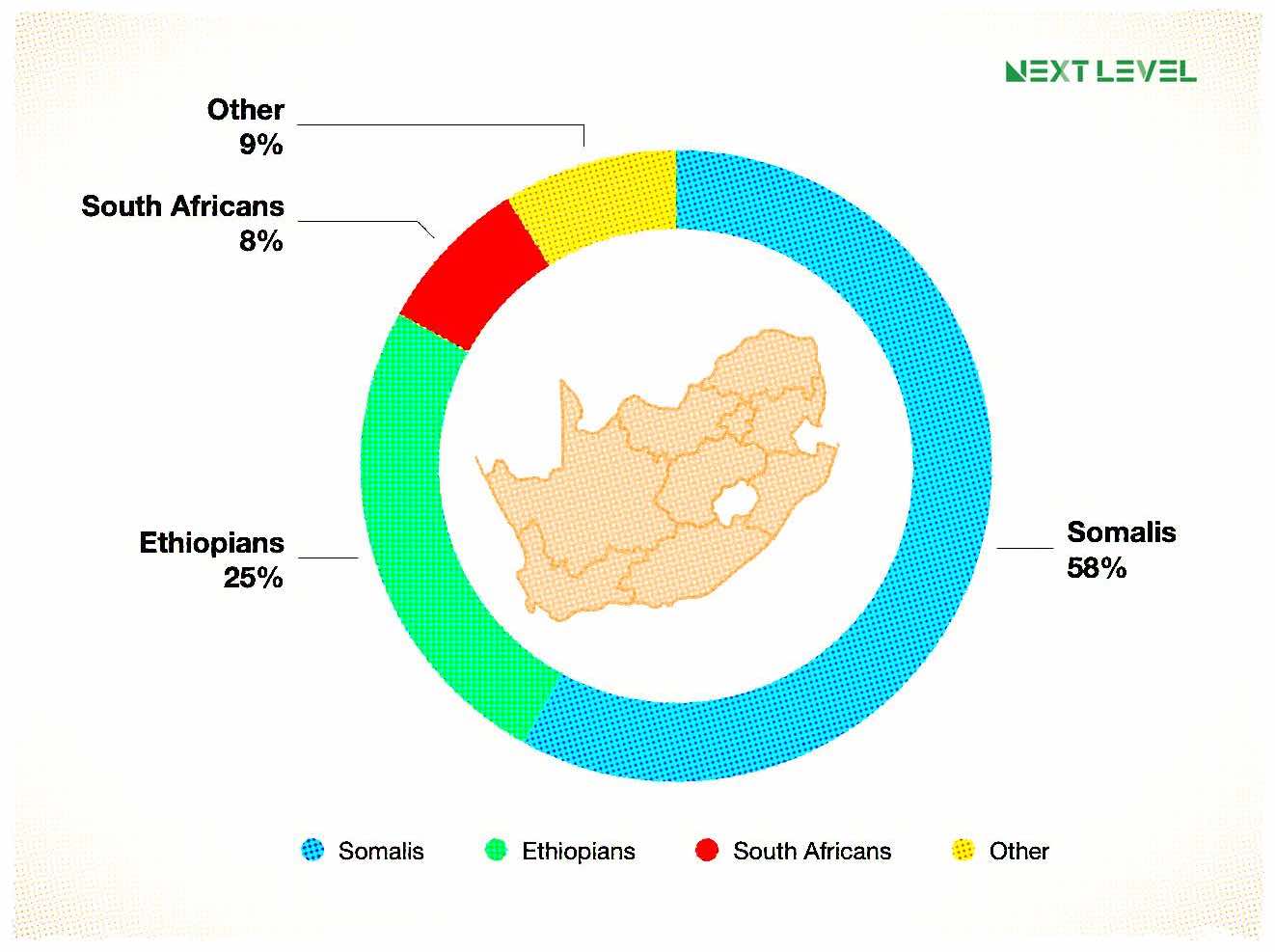
Caption: Spaza shop market share in South Africa
📷 NL-GRAPHICSForeign immigrants including refugees and asylum seekers have been able to penetrate and corner the sector because it has low barriers to entry and there are no laws that explicitly prohibit foreigners from owning or operating spaza shops.
The sector is also a juicy low-hanging fruit that generates R178 billion annually, making it a major component of the R1 trillion informal economy. In fact, spaza shops sit at top of the informal sector’s food chain, followed by a host of other businesses that are strong cash generators for foreign nationals such as hardware stores, hair salons, taverns, meat grill restaurants, and butcheries.
At the lower end of the informal sector’s food chain, there are all sorts of street-based businesses that range from cooked food vending, fresh fruit & vegetable hawking, dressmaking, second-hand clothing trading, tailoring to shoe-making, hairdressing, hair and beard cutting.
It is no wonder that SACR supports calls for introduction of laws that exclusively reserve ownership of spaza shops and other informal businesses for South African citizens. This is why the pressure group wants to ensure that SEDFA is allocating funds from SSSF to legitimate and rightful beneficiaries.
The SSSF was launched by the Department of Small Business Development (DSBD) and the Department of Trade, Industry and Competition (DTIC) to finance township and rural grocery stores owned by locals.
The fund is administered jointly by SEDFA and National Empowerment Fund (NEF). It offers a blend of grants and low-interest loans of up to R100, 000 to spaza shop owners. This blended funding is used for stock purchases, infrastructure and equipment upgrades.
SACR has announced that it intends to verify SEDFA’s information to ensure that taxpayers money is going to South African shopkeepers, thereby deterring fraud, fronting, and misuse of public funds.
According to the latest government update, 4,522 applications have been received so far, and 4,240 applicants have been assessed. The government announced that 2,369 businesses have been approved for funding valued at approximately R179.6 million.
Of these, SEDFA approved 1,316 applications worth R79.6 million, while the NEF approved 1,053 applications valued at R99.9 million.
To qualify for SSSF funding, applicants must be South African citizens and their businesses must have municipal trading permits.
Furthermore, applicants that receive funding exceeding R80, 000 must be registered with the Companies and Intellectual Property Commission (CIPC) and must have tax clearance certificates.