

NHI is many years away, unless health watchdog is properly funded

Caption:
The cash-strapped Office of Health Standards Compliance (OHSC) lacks capacity to inspect and certify healthcare providers that may be eligible to participate in NHI.
📷 NL-GRAPHICS DEPT
A few months ago I presented at a private hospital emergency department, all because instead of engaging in festivities with us, a relative, Lucy, took ill while visiting us in the Eastern Cape Province.
The experience shocked me into reckoning hard with the reality of the perilous state of health services in this part of the world.
Lucy was almost admitted into our version of the erstwhile Nessie Knight Hospital (commonly known as Sulenkama Hospital) – a dilapidated excuse for a rural health establishment in Qumbu. Thankfully, a more financially resourced relative intervened and saved her from spending the weekend in our hospital, albeit in pain.
Blood relations are amazing. She was whisked away to a private hospital and within a few hours underwent a procedure to remove her troublesome appendix.
A horse, a horse, my kingdom for a horse
I knew instantly that my own lack of sufficient proximity with such powerful blood relations would have condemned me to a weekend in my own version of Sulenkama suite, waiting for a doctor to only throw the bones the following Monday, before anything could be done.
I would have to be strong! What I would give to secure my own health! I would give a kingdom for the horse that is my fuel and health.
Among other things, this new found appreciation for my hopelessness made me ask: is there no standards bearer to protect me from poor public healthcare since I can’t afford private healthcare? Soon I found out there is, and it is called the Office of Health Standards Compliance (OHSC).

Caption: Paralegal graduate Viwe Fatyi
📷 SUPPLIEDIn terms of the National Health Act 12 of 2013 (NHA), the OHSC’s primary purpose is to promote and protect the health and safety of people who use healthcare services – its legal mandate.
It does this by monitoring and enforcing compliance with prescribed health norms and standards in healthcare establishments. The norms and standards were promulgated in 2018.
The OHSC covers both public and private healthcare establishments including hospitals, primary healthcare clinics, emergency medical services, hospices, private medical practitioners and nursing care facilities.
Since it is essentially a regulator of health standards, the OHSC accounts to Parliament.
The OHSC, Health Portfolio Committee and NHI
To better understand how the OHSC functions I delved into Parliament’s archives and stumbled onto this YouTube url - Portfolio Committee on Health for the OHSC’s last appearance before Parliament on 29 April 2026.
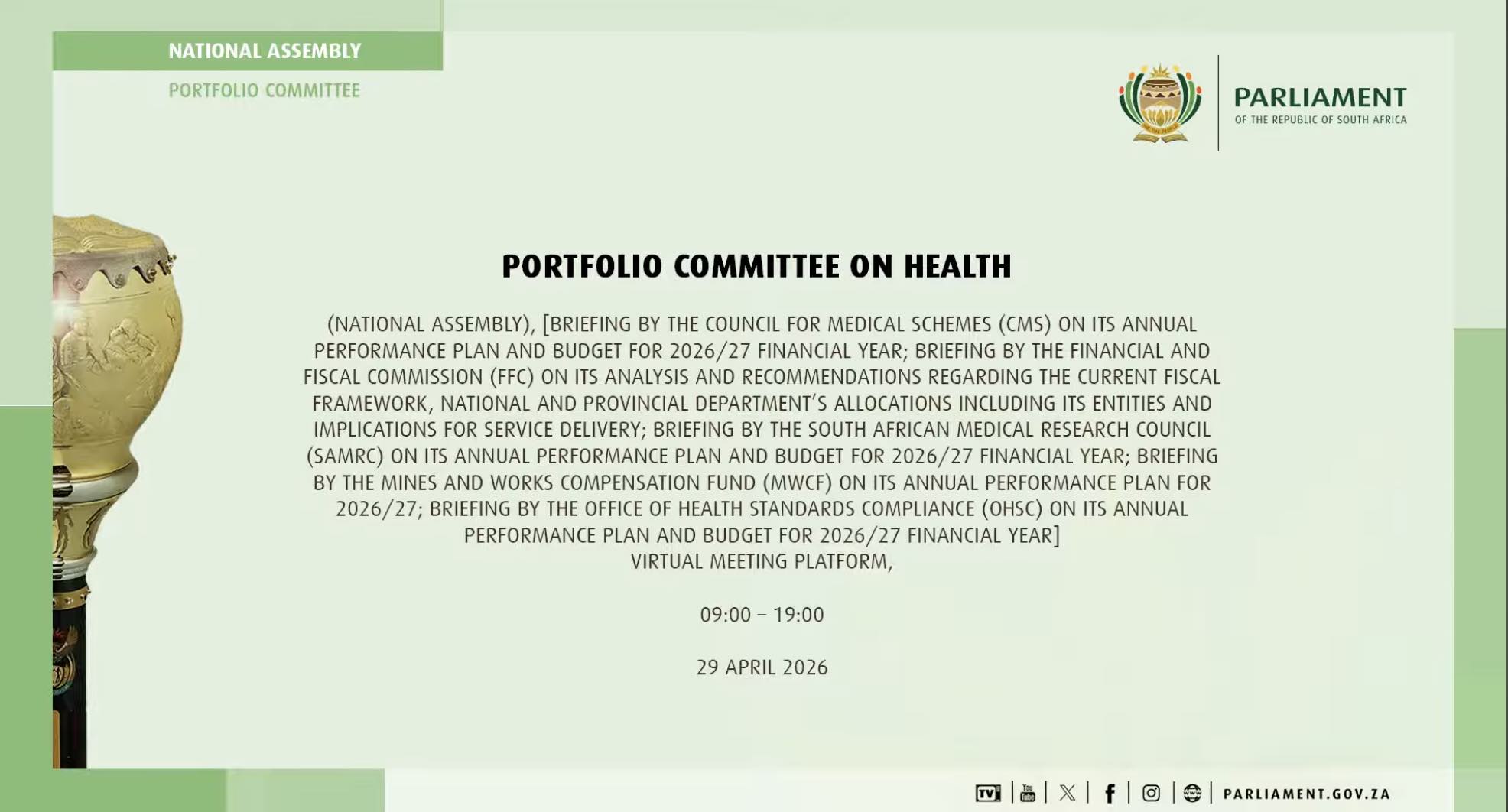
Caption: OHSC’s last appearance before Parliament on 29 April 2026.
Listening in to the Parliamentary discussions that took place on the day, it became clear that the OHSC fulfils its legal mandate by carrying out inspections of health establishments throughout the country, assess if they comply with norms and standards, and issue certifications where compliance is proved or a variety of enforcement actions where the contrary prevails.
For example, enforcement is dealt out where a health establishment is constantly in breach of the following:
- Maintaining adequate supplies of essential medicines,
- Procuring medical equipment like monitors of unborn babies’ heart rates in maternity wards to prevent babies being born with cerebral palsy,
- Keeping required compliance certificates in terms of building regulations,
- Ensuring that patients and their caregivers are not subjected to oppressively long waiting hours when seeking health services.
While it became evident that a lot needed to be discussed, it equally became clear that not nearly enough time was reserved to ensure full ventilation of the challenges the OHSC faces. I could not avoid thinking the whole thing was a compliance exercise by the very Committee tasked with ensuring the OHSC is kept honest to its mandate.
The raw data that emanated from the discussions includes the following:
- There is no certainty regarding the number of health establishments that must be inspected in the country.
- There is no consensus regarding what the budget of the OHSC should be (its financial statements reveal a paltry sum of approximately R206 million annually).
- The OHSC has an incredibly low number of 43 inspectors to inspect tens of thousands of hospitals, clinics, private health care practices (including premises of GPs, nurses, physiotherapists, chiropractors, and countless aesthetic clinics).
- The current annual inspection rate is less than what the monthly inspection rate should be.
Other than the legal mandate referred to above, the National Health Insurance Act 20 of 2023, signed into law on 15 May 2024, requires that, to be eligible to participate in the current government’s preferred mode of delivering universal health care – the envisaged NHI Fund – health establishments must obtain certification from the OHSC.
Effectively, this requirement imposes urgency on the work of the OHSC. Where before the OHSC could have taken an indefinite period to inspect and periodically re-inspect health establishments, focusing on high risk institutions, it now needs to certify huge numbers albeit only compliant ones relatively soon.
Universal health care is likely not coming soon
This was not lost to the Parliamentary Portfolio Committee. Forced to say if the OHSC can reassure South Africans of its capacity to meet the mandate or support the NHI, its CEO Dr Siphiwe Mndaweni firmly declined to do so.
She confirmed to MPs that, with the current capacity and severe financial constraints, it would take ‘many many years’ before the OHSC was able to fulfil its legal mandate and support the NHI.
Dr Mndaweni detailed failed attempts to secure additional funding from both National Treasury and the Ministry of Health. She informed the Committee that the OHSC was informed in no uncertain terms by the Ministry that there was currently no plan to increase OHSC funding… so the OHSC is operating on austerity measures.
And there lies the rub
Dr Mndaweni admitted that the huge national contingent liability for medical negligence claims were derived mostly from non-compliance with the norms and standards. Put differently, unless the OHSC is significantly capitalised, universal health care is only a dream and millions of South Africans, like myself, will continue to be on the receiving end of poor health services.
This being an municipal elections year, it was not lost to me that on the eve of the last national elections, one Panyaza Lesufi, Premier of Gauteng province, promised a hopeful gathering of elders that they would literally waltz into private hospitals, when the need arose, if they voted for the African National Congress (ANC) in the last elections.
The party would usher in NHI and ordinary folk would be free from violations brought by negligent medical care.
President Cyril Ramaphosa signed the NHI Act into law on 15 May 2024, the elections followed on 29 May 2024. The NHI Act did not come into operation. It will follow, only many, many years from now.
Viwe Fatyi is a paralegal graduate and an aspiring legal practitioner. She currently resides in kuGompo, Eastern Cape and writes in her personal capacity.